The camel
Riding a dromedary at sunset: what to know
What the one-humped camel is, how it copes with dry ground, how a camel ride feels, and what to wear for it.
See this evening's dates ↗Quick answer
The camel on a desert ride is a dromedary, the one-humped camel. Wikipedia says it was probably first domesticated in the southern Arabian Peninsula and is built to cope with heat and little water. A ride is slow and swaying rather than fast, so wear closed shoes and long trousers and expect to climb on while the animal is kneeling.
The dromedary in brief
| Feature | What Wikipedia says | What it means on a ride |
|---|---|---|
| Hump | A store of fat, not of water | The hump is a seat landmark and a food reserve |
| Water | Can tolerate losing more than 30 per cent of its water | Built for long dry stretches |
| Eyes and nose | Double eyelashes, bushy eyebrows and nostrils that close | Protection from dust and wind |
| Feet | Padded and suited to sand and rough ground | Good grip on gravel, poor on slippery ground |
Which camel is it?
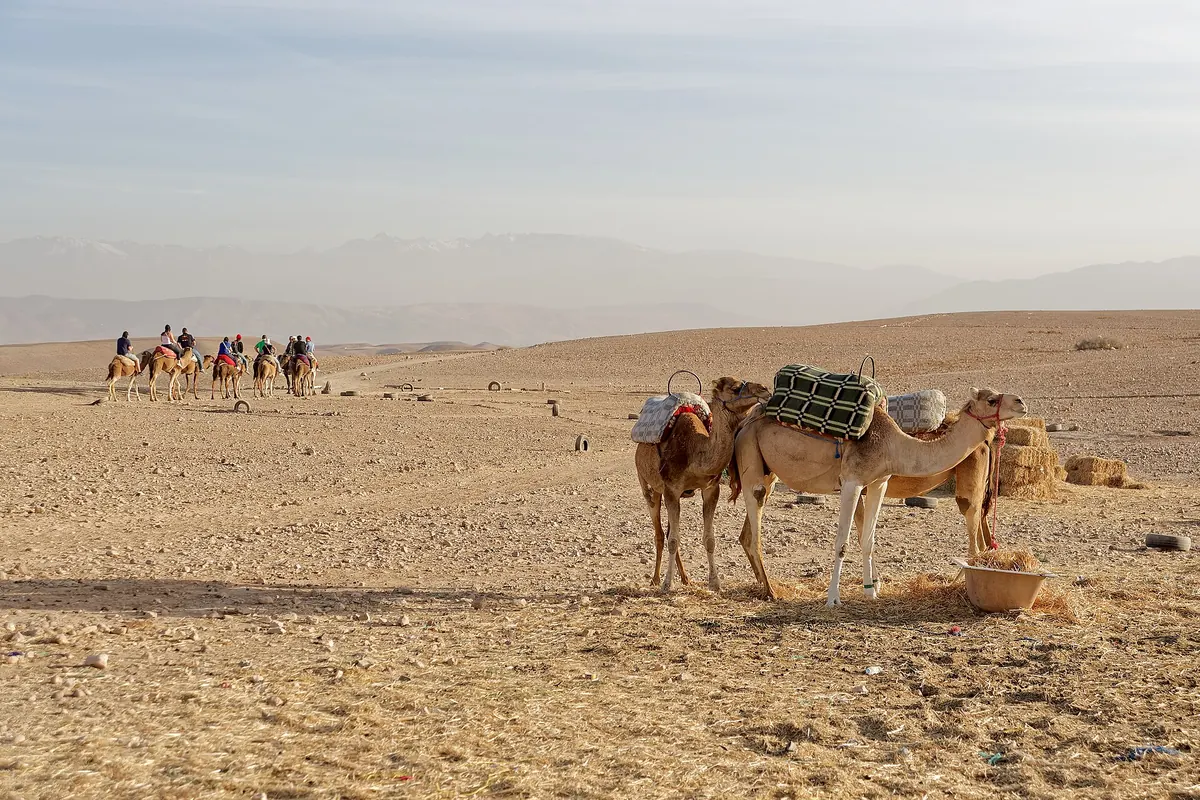
A camel in Morocco is a dromedary, Camelus dromedarius, the one-humped camel. Wikipedia describes it as the tallest of the three camel species, with a long curved neck, a single hump and long hairs on the throat, shoulders and hump. The Bactrian camel, with two humps, belongs to Central Asia. If your camel has one hump, you are on the right animal for North Africa.
A very old working animal
The dromedary has a long working history. Wikipedia says it was first domesticated in the southern Arabian Peninsula around 4000 to 3000 BC. After the Islamic conquest of North Africa, camels were imported in large numbers, which increased trans-Saharan trade because they could carry heavy loads on long desert journeys. A sunset ride today is a small echo of that history, in a landscape that sits at the edge of the old caravan world.
Built for dry ground
The dromedary's body is adapted to heat and scarcity. Wikipedia says it can reduce water loss by letting its body temperature rise and fall through the day, tolerates losing more than 30 per cent of its water, closes its nostrils voluntarily and is protected from dust by thick eyelashes and bushy eyebrows. Its hump stores fat, which can be broken down for energy when food is scarce. Padded feet carry its weight on sand and rough ground, although Wikipedia notes they are not suited to slippery or muddy surfaces. None of this changes how you ride, but it explains why the animal looks so calm in difficult country.
What a ride feels like
A camel ride is slow and rhythmic. Wikipedia says the dromedary moves both legs on one side of the body together, which produces the characteristic roll, and walking is its everyday gait. You mount while the animal is kneeling and hold on as it stands, so keep your grip firm at that moment. Riders usually sit in a line led by a handler. It is relaxing, slightly swaying and quiet, with time to look at the light. It is not suitable as a fast ride, and it is not meant to be.
What to wear
Closed shoes, long trousers and a hat are more comfortable than shorts and sandals. Saddles rub bare legs, dust gets into sandals and a hat helps in the sun. Bring a light layer for after dark. Keep your phone secure in a zipped pocket rather than loose in your hand while the animal gets up.
Respecting the animal
Camels are working animals, so it is reasonable to ask the handlers how they look after them, especially in heat. Wikipedia says the dromedary can go long periods without drinking, which has no bearing on a short ride. If an animal looks unwell or overloaded, tell the seller. Most visitors find a calm, well-handled animal makes the ride far more enjoyable.
Frequently asked questions
Is a camel ride safe for children?
The page does not give an age rule that we can see. Ask the seller about minimum ages and whether a child can share a saddle.
Will I be able to get on and off easily?
Yes, with help. The camel kneels while you mount and dismount, and the handler guides you.
Does the ride last long?
The page does not give a ride duration. The whole evening is listed at seven hours, so the ride is only part of it.
Sources
- Dromedary on Wikipedia, for the animal, its history and its adaptations
- Agafay Desert on Wikivoyage, for clothing and sun advice
- Desert pavement on Wikipedia, for the stony ground the camels cross
- Berbers on Wikipedia, for the people who live and trade across this region
- Atlas Mountains on Wikipedia, for the range behind the plain
- Moroccan cuisine on Wikipedia, for the meal that follows the ride